Dickens created worlds large enough that you could move around in them. He did not confine himself to the narrow focus of a few neurotic characters and their shell-shocked egos; he created worlds, in the closing words of Little Dorrit, where "the noisy and the eager, and the arrogant and the forward and the vain, fretted, and chafed, and made their usual uproar."
"Little Dorrit" opens with the information that the story will be told in two parts, the first through the eyes of Arthur Clennam, the second through the eyes of Little Dorrit. The two parts of the film contain many of the same scenes, seen from different points of view and remembered differently, so that half a line of throwaway dialogue in the first version may turn out, in the second version, to have been absolutely crucial. The use of two different points of view is not a conceit of the filmmakers, but creates a real romantic tension, because it is clear from the outset that Clennam and Little Dorrit are in love with each other - and neither one has any way of admitting that fact.
And yes, the story is on the surface a "romance", but it is also about goodness and evil, loyalty, self-sacrifice and self-entitlement, and social injustice and the inefficiency and failings of bureaucracy, and most of all about fortunes lost, and found, and lost again, greed, wealth and poverty, and money, money, money...
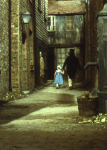
Unlike many British costume dramas, Little Dorrit was not filmed "on location" or in lavish National Trust manor houses... instead, Edzard's soundstage recreation of interiors and exteriors ranging from the tenement houses of Bleeding Heart Yard, to the Marshalsea debtor's prison, to halls of the Office of Circumlocution, to the home of the wealthy financial speculator Merdle, and that of the middle-class Meagles family, and the filthy, crowded streets of London is a glorious evocation of the England of the 2nd quarter of the 19th century, with my sole quibble being the odd, flat lighting of the "exterior" scenes.
The costuming is impeccable, and the air of authenticity is heightened by hair, makeup and costume all showing character-appropriate deference to the personal hygiene practices of the time.
The cast of dozens includes stellar performances by Sir Derek Jacobi (as Arthur Clennam), Sir Alec Guinness (who received the Academy Award for Best Supporting actor, in one of his final roles, as William Dorrit, Little Dorrit's father), Miriam Margolyes (both hilarious and touching, as the girl Mr. Clennam left behind, some 20 years ago) and Sarah Pickering (in the title role, in what I believe is her only film credit).
As may be apparent from my gushing, I dearly love this film (and the original book). Despite my affection (or perhaps because of it), I am the first to admit that it is not for everyone, as they say... it is very slow-paced, with both the character and story developing at a languid pace; the plot is twisty-turny and at times incomprehensible, at least until you've watched the entire film; and the dialogue sometimes seems to be in some sort of code, yet it is exactly as Dickens wrote it. While not "light viewing," it is, however, a film that reveals itself most fully after multiple viewings.
Coming this autumn on DVD (finally!)... the theatrical trailer can be seen on YouTube.