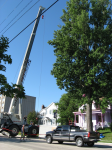
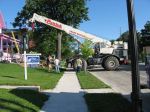
We are in the process of replacing the "tower" (or cupola or whatever you like to call it) on our 1881 Queen Anne in Marinette, WI. The current tower is a poor-quality reproduction from 1990 or so. The original was struck by lightning and burnt off in, say, the 1920s, as best I can figure.
We are also working on the dentil molding & corbels that go around the porch header...lots of work in-process here. Perhaps we will get to the gingerbread next year.
The larger porch was added around 1905...we restored it two years ago with Italianate columns reverse-engineered from the 1881 porch along with flat-sawn balusters (rather than the classic columns & spindles from the 1905 re-do). So, we kept the 1905 porch footprint, but used the 1881 element designs.
The cresting for the new tower ships today or tomorrow. The new tower will go up some time next month. I reverse-engineered it from photos and some lucky finds in architectural resources. Note the photo of the neighbor's house with mine in the background at left...they were built identical, give or take, for brothers.
If anybody has seen a similar house in an old book of house plans, please let me know.
Thank you,
Jason
My Queen Anne -- 1881 Victorian
Archive summary
Victorian Homes & Buildings thread on victorianforum.com · started April 21, 2008 by 1881victorian · 23 posts, 29 image attachments · discussion in 2008–2009.
We are in the process of replacing the "tower" (or cupola or whatever you like to call it) on our 1881 Queen Anne in Marinette, WI. The current tower is a poor-quality reproduction from 1990 or so. The original was struck by lightning and burnt off in, say, the 1920s, as best…

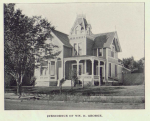
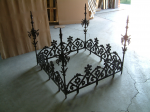
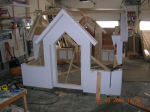
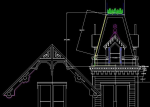
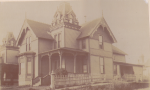

Some additional photos. The Menominee River (border between WI and MI's Upper Peninsula) is in front of the house. The 1912 photo shows the bigger porch (at far-left).
- Jason
PS - I should mention that many of these old photos were taken in the spring time when the river was full of logs floating down to the sawmills that built this part of the country.
- Jason
PS - I should mention that many of these old photos were taken in the spring time when the river was full of logs floating down to the sawmills that built this part of the country.
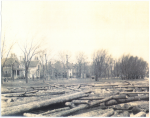
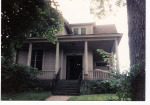
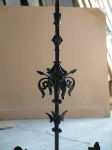
Just for fun...
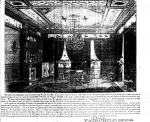
The image below is an advertisement from the local newspaper. I suspect that the ad ran more than once, but the particular copy that I have here is dated March 29, 1884. The first owner of my house was Charles Fairchild...one of the two "Fairchild Bros" of Marinette, Wisconsin. They had a "drug store" that, in addition to prescription medication, sold all manner of things, including musical instruments and wallpaper.
All apologies for the quality of the attached image...a copy of a copy from a microfilm, etc. The caption reads as follows.
The above cut represents a room decorated with WALL PAPER, in the latest style of the art. Our trade in this line has kept pace with the rapid advancement made in the art of wall-decorating, till now, we carry the LARGEST STOCK OF WALL PAPER in the state, outside of Milwaukee, and our facilities for doing all classes of work are unexcelled any-where. We have practical paper-hangers who execute all work under our personal supervision, hence satisfaction is guaranteed in every case. Notwithstanding we have done a large amount of this class of work, yet only two instances where paper has failed to stick to the walls have come to our notice. This is a record surpassed by no other firm.
As to prices, we will pledge to furnish both materials and labor as low as any other firm in this section, and at least 25 per cent below Chicago or Milwaukee figures. We are better prepared this year than ever before to furnish all grades of paper, our stock being comprised of nearly ONE THOUSAND PATTERNS, carefully selected from different manufactories, both foreign and domestic. You will observe by glancing thro' our line of samples that colorings are somewhat lighter and considerably gayer than last year, being a change in the right direction. We sometimes--rarely, however,--have to combat the argument that ceiling decorations will soon grow into disfavor, but let us here state to the skeptical, as regards this point, that they are more popular to-day than ever before. Anyone who has seen a tastefully decorated ceiling will at once admit its superiority over a plain white one. In fact, it is just as essential to treat the ceiling of a room with paper, as its walls, and too, we affirm that the same amount of money your wall decorations would cost, expended in any other direction, would not go nearly so far towards the furnishing of your home, and that less furniture and fewer pictures are necessary to make it beautiful and home-like.
Very Respectfully,
FAIRCHILD BROS.
The image below is an advertisement from the local newspaper. I suspect that the ad ran more than once, but the particular copy that I have here is dated March 29, 1884. The first owner of my house was Charles Fairchild...one of the two "Fairchild Bros" of Marinette, Wisconsin. They had a "drug store" that, in addition to prescription medication, sold all manner of things, including musical instruments and wallpaper.
All apologies for the quality of the attached image...a copy of a copy from a microfilm, etc. The caption reads as follows.
The above cut represents a room decorated with WALL PAPER, in the latest style of the art. Our trade in this line has kept pace with the rapid advancement made in the art of wall-decorating, till now, we carry the LARGEST STOCK OF WALL PAPER in the state, outside of Milwaukee, and our facilities for doing all classes of work are unexcelled any-where. We have practical paper-hangers who execute all work under our personal supervision, hence satisfaction is guaranteed in every case. Notwithstanding we have done a large amount of this class of work, yet only two instances where paper has failed to stick to the walls have come to our notice. This is a record surpassed by no other firm.
As to prices, we will pledge to furnish both materials and labor as low as any other firm in this section, and at least 25 per cent below Chicago or Milwaukee figures. We are better prepared this year than ever before to furnish all grades of paper, our stock being comprised of nearly ONE THOUSAND PATTERNS, carefully selected from different manufactories, both foreign and domestic. You will observe by glancing thro' our line of samples that colorings are somewhat lighter and considerably gayer than last year, being a change in the right direction. We sometimes--rarely, however,--have to combat the argument that ceiling decorations will soon grow into disfavor, but let us here state to the skeptical, as regards this point, that they are more popular to-day than ever before. Anyone who has seen a tastefully decorated ceiling will at once admit its superiority over a plain white one. In fact, it is just as essential to treat the ceiling of a room with paper, as its walls, and too, we affirm that the same amount of money your wall decorations would cost, expended in any other direction, would not go nearly so far towards the furnishing of your home, and that less furniture and fewer pictures are necessary to make it beautiful and home-like.
Very Respectfully,
FAIRCHILD BROS.
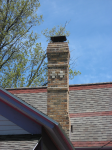
We recently had our local mason come out and inspect the chimneys. In the end, he re-built 3 of our 4 smoke stacks. We figured that the little one on the carriage house and the little one on the summer kitchen were no longer structurally sound, but we were surprised to learn that the main fireplace chimney had been damaged (probably during the re-roofing & flashing). The main fireplace chimney had probably been re-built in the 1920s, so I took the opportunity to sketch out something a little more Victorian to replace the plain, rectangular, 20th-century model. I found some similar outlines and elements in a Dover book (Comstock's "Victorian Domestic Architectural Plans and Details"). The finished product looks pretty good...something of a bonus project this spring.
The tower project is also progressing. I hope to see it installed within the month. Several elements have yet to be installed on the new tower, but the structure is coming along nicely.
Thank you,
Jason
The tower project is also progressing. I hope to see it installed within the month. Several elements have yet to be installed on the new tower, but the structure is coming along nicely.
Thank you,
Jason
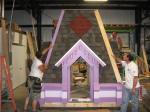
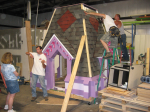
Our new tower was erected a week ago...it made the front page of the local paper today.
http://ehextra.com/main.asp?SectionID=12&SubSectionID=35&ArticleID=1867&TM=34826.95
There is still more work to do before this little project is finished, but I think that we will be very pleased with the final results.
The original staircase winds its way all the way up into the new tower, so it will be functional space once finished on the inside (a winter project). There ought to be enough room for a recamier and a small table or tiny bookcase. Alternatively, our son (16 months old now) may some day claim the tower as yet another play room. We have heard stories that the identical tower that used to be on the neighbor's house served as a full-time bedroom for two boys back in the day. Now there is an odd thought.
- Jason
http://ehextra.com/main.asp?SectionID=12&SubSectionID=35&ArticleID=1867&TM=34826.95
There is still more work to do before this little project is finished, but I think that we will be very pleased with the final results.
The original staircase winds its way all the way up into the new tower, so it will be functional space once finished on the inside (a winter project). There ought to be enough room for a recamier and a small table or tiny bookcase. Alternatively, our son (16 months old now) may some day claim the tower as yet another play room. We have heard stories that the identical tower that used to be on the neighbor's house served as a full-time bedroom for two boys back in the day. Now there is an odd thought.
- Jason

Beautiful home, I know your very proud! :)
Any new pictures of the final product?
They have yet to finish the siding, dentils, & stud doo-dads just below the tower. On the up-side, the front half of the main roof is now done, complete with the two-tone "racing stripes". The roof over the front porch still isn't done though on account of scaffolding sitting atop that surface. I continue to hope that they will come & finish any day now. I'll post some pics once that project is done. Perhaps next year we can get around to doing the gingerbread under the gables.
Speaking of which, I finally thumbed through a Dover copy of "Woodward's National Architect" of 1869 and, lo und behold, I have finally found my tower (plate no. 85, but different window shape), the original porch railing (plate no. 65), details of the original gingerbread (plate no. 27), and the original roof cresting (plate no. 16). I'm still looking through the book, but it appears that a lot of the construction details are identical too. It had not occured to me to check an 1869 reference for a house built in 1881...Marinette does tend to be behind the times though.
Despite the identical features found in Woodward, my hunch is that the basic floorplan is an enlarged version of Palliser's "model gothic cottage" of 1876, but I have yet to track down a copy of the Palliser floorplan.
If we accept the classification of the house as a Victorian gothic revival, then it was one of the last of its kind given as that the style of architecture is generally lumped between 1840 and 1880. In reading Daniel Reiff's "Houses from Books", he describes one house built similar to the Palliser design as "either Italianate or perhaps 'Victorian Eclectic'". This description makes a bit more sense to me given as that the house has a blend of elements from Gothic, Italianate, & Second Empire styles. Perhaps this is grounds to simply call the place an early Queen Anne (?)...which is what I have done to date.
Regardless, it ain't no Barber house and, as such, will never be quite as beautiful as Raymanretro's example.
Thank you,
Jason
Speaking of which, I finally thumbed through a Dover copy of "Woodward's National Architect" of 1869 and, lo und behold, I have finally found my tower (plate no. 85, but different window shape), the original porch railing (plate no. 65), details of the original gingerbread (plate no. 27), and the original roof cresting (plate no. 16). I'm still looking through the book, but it appears that a lot of the construction details are identical too. It had not occured to me to check an 1869 reference for a house built in 1881...Marinette does tend to be behind the times though.
Despite the identical features found in Woodward, my hunch is that the basic floorplan is an enlarged version of Palliser's "model gothic cottage" of 1876, but I have yet to track down a copy of the Palliser floorplan.
If we accept the classification of the house as a Victorian gothic revival, then it was one of the last of its kind given as that the style of architecture is generally lumped between 1840 and 1880. In reading Daniel Reiff's "Houses from Books", he describes one house built similar to the Palliser design as "either Italianate or perhaps 'Victorian Eclectic'". This description makes a bit more sense to me given as that the house has a blend of elements from Gothic, Italianate, & Second Empire styles. Perhaps this is grounds to simply call the place an early Queen Anne (?)...which is what I have done to date.
Regardless, it ain't no Barber house and, as such, will never be quite as beautiful as Raymanretro's example.
Thank you,
Jason
Quote from: 1881victorian
Despite the identical features found in Woodward, my hunch is that the basic floorplan is an enlarged version of Palliser's "model gothic cottage" of 1876, but I have yet to track down a copy of the Palliser floorplan.
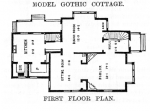
Jason, I have a reprint of Palliser's 1876 pattern book, which shows the Model Gothic Cottage ("this house can be built for about $3,000") + First Floor Plan. If this would be helpful to you, I can scan the page and post it (or e-mail it, if you'd like something hi-res).
regards-
Cheryl
Cheryl:
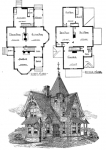
I'd love to see the floorplan of the 1876 Model Gothic Cottage. I have been trying to find a library copy of the '76 Palliser book (or the 1970s re-print) with little luck thus far. I have in on my desk a copy of the '78 Palliser book...the rooms in our house are arranged somewhat similar to (but bigger than) Plate VI "Residence of Albert Trinler, New Albany, Ind." which claims to be derived from "design No. 22" of the '76 Palliser book. Our staircase is in a different location, the dining & sitting rooms are mirrored, and we have an additional chamber/bedroom alongside the kitchen at the back of the house...not to mention the rear bathroom & summer kitchen additions of the 1890s and 1905-ish front porch.
I still need to go shopping for curtains (thank you again for the wonderful write-up!), but, if you do have a bit of free time, I would very much appreciate seeing a scanned copy of your '76 Model Gothic Cottage first floor plan.
[email removed]
- Jason
I'd love to see the floorplan of the 1876 Model Gothic Cottage. I have been trying to find a library copy of the '76 Palliser book (or the 1970s re-print) with little luck thus far. I have in on my desk a copy of the '78 Palliser book...the rooms in our house are arranged somewhat similar to (but bigger than) Plate VI "Residence of Albert Trinler, New Albany, Ind." which claims to be derived from "design No. 22" of the '76 Palliser book. Our staircase is in a different location, the dining & sitting rooms are mirrored, and we have an additional chamber/bedroom alongside the kitchen at the back of the house...not to mention the rear bathroom & summer kitchen additions of the 1890s and 1905-ish front porch.
I still need to go shopping for curtains (thank you again for the wonderful write-up!), but, if you do have a bit of free time, I would very much appreciate seeing a scanned copy of your '76 Model Gothic Cottage first floor plan.
[email removed]
- Jason
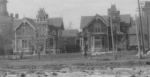
Attached is a zoom-in of the circa-1900 panoramic photo of Riverside Ave, Marinette, WI. Our house is on the left. Does anybody have an opinion as to whether or not these are Palliser "model gothic cottages"?
Thank you,
Jason
Thank you,
Jason
Quote from: 1881victorian
Attached is a zoom-in of the circa-1900 panoramic photo of Riverside Ave, Marinette, WI. Our house is on the left. Does anybody have an opinion as to whether or not these are Palliser "model gothic cottages"?
Thank you,
Jason
With some minor differences in detailing and proportions, they are dead ringers for the drawing in the 1876 Palliser pattern book, Jason. I'll send you a hi-res scan later this evening, and post a smaller image here on the board so everyone can compare.
~Cheryl
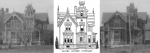
I've taken the liberty of "inserting" the drawing of the Model Gothic Cottage into Jason's wonderful photograph, to facilitate comparison of the design "as conceived" and "as built".
The massing of the plan and the actual buildings are virtually identical, with the significant differences being in the detailing. The following are the most obvious deviations from the pattern book drawing:
It is as if the "Model Gothic Cottage" design was "modernized" with a Queen Anne makeover, perhaps by an enterprising builder, something I think was probably pretty common (especially in rural areas).
The massing of the plan and the actual buildings are virtually identical, with the significant differences being in the detailing. The following are the most obvious deviations from the pattern book drawing:
[li]The 1st floor side bay moves from the right side facade to the left side facade;[/li]
[li] the projecting 1st floor bays in the photograph seem to have canted corners, rather than squared sides;[/li]
[li]the Cottage in the pattern book drawing has a more vertical emphasis, while the built examples have a more horizontal footprint, in large part due to the cross-gabled block extending beyond the main block on both sides rather than on only one;[/li]
[li]the 2nd floor window hoods are absent from the built examples, as are the irregular roofline and the dormer projecting from the left side of the front gable-end and the small, on-point windows (?) centered at the top of the two front bays;[/li]
[li]the windows are much larger as built, giving the fenestration a more prominent role;[/li]
[li]the Stick and "Swiss Chalet" detailing of the built examples, replacing the Gothic trim;[/li]
[li]and the addition of larger, wrap-around entry porches.[/li]
It is as if the "Model Gothic Cottage" design was "modernized" with a Queen Anne makeover, perhaps by an enterprising builder, something I think was probably pretty common (especially in rural areas).
Cheryl:
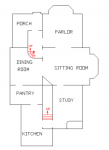
The round staircase in the 1876 Palliser floorplan was one of the last bits of evidence that I was looking for. We have roughly the same staircase, but the base of the stairs is farthest from the front door. The entire stair tower has been pushed into our dining room, leaving us with a nice round wall in both the dining room and the bedroom above (the stairs wind all the way into the tower). Having the sitting room directly across from the dining room (and bedrooms above) helps to explain the straight roofline. Our sitting room, excluding bay window, is quite nearly 15' x 20' thanks to the removal of the closets between the sitting room & parlor as well as the increased width of the house just aft of the parlor. Our parlor may have roughly the same dimensions (around 14' x 14'). Our fireplace is in the sitting room. Any rear veranda that might have been contemplated would have come off of the sitting room adjacent to the study (there was originally a door there, but probably no veranda -- just steps).
Despite the similarities, there was a lot of tinkering with room sizes & layouts. Still, it seems to be obvious that the 1876 Palliser design was the starting point for what we have with a dash of elements from Woodward's 1869 book.
I have attached a sketch of our house's original floorplan as well as the 1876 Palliser floorplan that you sent to me. Thank you very much! I'm also attaching a copy of Plate VI from Palliser's 1878 book as it has the canted bay windows and sitting & dining rooms in-line with one another.
- Jason
The round staircase in the 1876 Palliser floorplan was one of the last bits of evidence that I was looking for. We have roughly the same staircase, but the base of the stairs is farthest from the front door. The entire stair tower has been pushed into our dining room, leaving us with a nice round wall in both the dining room and the bedroom above (the stairs wind all the way into the tower). Having the sitting room directly across from the dining room (and bedrooms above) helps to explain the straight roofline. Our sitting room, excluding bay window, is quite nearly 15' x 20' thanks to the removal of the closets between the sitting room & parlor as well as the increased width of the house just aft of the parlor. Our parlor may have roughly the same dimensions (around 14' x 14'). Our fireplace is in the sitting room. Any rear veranda that might have been contemplated would have come off of the sitting room adjacent to the study (there was originally a door there, but probably no veranda -- just steps).
Despite the similarities, there was a lot of tinkering with room sizes & layouts. Still, it seems to be obvious that the 1876 Palliser design was the starting point for what we have with a dash of elements from Woodward's 1869 book.
I have attached a sketch of our house's original floorplan as well as the 1876 Palliser floorplan that you sent to me. Thank you very much! I'm also attaching a copy of Plate VI from Palliser's 1878 book as it has the canted bay windows and sitting & dining rooms in-line with one another.
- Jason
Jason,
I am really tickled that you were able to further "nail down" the origin of your house's plans! I believe that Palliser was one of the firms which offered customization of the designs in their plan books, so elements such as a bay or staircase appearing in a different location isn't surprising; a skilled builder would also be able to alter plans to the owner's specs, local tastes or to site requirements.
~ Cheryl
I am really tickled that you were able to further "nail down" the origin of your house's plans! I believe that Palliser was one of the firms which offered customization of the designs in their plan books, so elements such as a bay or staircase appearing in a different location isn't surprising; a skilled builder would also be able to alter plans to the owner's specs, local tastes or to site requirements.
~ Cheryl
Cheryl:
Thank you for your help in gaining insight about what was going through the mind of the builder of my house back in the day. My hunch is that the builder, a Mr. John Crockett, was familiar with the Palliser design and set about building a clone using elements from the Woodward book. Mr. Crockett was certainly capable of such a task. His obituary indicates that he "was acting contractor and builder of the local court house, and jail and also many of the more pretentious homes in the city". Mr. Crockett had no living descendants at the time of his death, but I see that the obituary lists a brother and a nephew. I doubt that any architectural drawings that once belonged to the fellow survive to the present day.
We hit another milestone today. Today marks the first time that we have ever had a piece of ceiling plaster fall down. When the front porch was enlarged to wrap around the parlor (around 1905), the front doors were re-located closer to the river (more towards the front of the house). A "new" door was then placed where the old front doors had been, thereby creating a little entry foyer. This was a common modification around here so as to keep the snow from blowing directly into the house (old photos show temporary/seasonal entry chambers on other houses around here...they tended to look like an outhouse up against the front door). The porch roof over this "new" entry foyer was re-worked so as to be flat. That flat spot on the porch roof has been leaking a tiny bit over the last 10 years. Of course, like any other project, there are first things first...such as the tower. Get the tower fixed (which also leaked), then you can get a new roof which, in turn, should fix the leak.
So, the exterior portion of the tower project is quite nearly done (they have been hard at work lately), but the force of gravity finally overcame the force of habit and a chunk of ceiling plaster came down. This isn't particularly upsetting...less effort to bring the ceiling down once the porch roof is done.
On a mostly-unrelated topic, a friend was over the other day and asked when I would get around to replacing the slate fireplace hearth that the previous owner put in. I said that we intend to replace the slate with an appropriate Victorian tile, but we can't do that until we order ceiling paper. The friend didn't understand the connection...if I replace the slate, then it makes sense to replace the ugly fireplace surround and mantle that the previous owner created. If I replace the mantle, then the wallpaper will likely show gaps around the new/replacement/antique mantle. If I am to replace the wallpaper, then it needs to coordinate with ceiling paper. ...not to mention any wiring projects that need to be addressed.
We have a few other small victories to report. We now have a "new" floor & foundation under half of the garage (carriage house). The mason finished that up a week or two ago. The old foundation and floor had split and half of the structure had sunk about 6 inches. I re-sided the carriage house several years ago in the as-sunk condition (budget issues at the time). The mason dug out the bad section of floor, jacked up the old foundation (a few inches, not all the way -- I don't aim for perfection here and I like the character of the subtle bend in the building), poured new footings below the old foundation, and poured about half of a new floor (the other half wasn't bad to begin with). Separately, we re-sided a narrow wall on the house this past Saturday. The previous owners had done a bad wood siding job on that narrow wall (no back-priming and a tiny roof leak). The roof over that wall was replaced last year...we replaced the siding on the wall with the same cedar siding that I had put on the carriage house...but we were smart and pre-painted it this time.
Maybe we will still get to gingerbread next year.
- Jason
Thank you for your help in gaining insight about what was going through the mind of the builder of my house back in the day. My hunch is that the builder, a Mr. John Crockett, was familiar with the Palliser design and set about building a clone using elements from the Woodward book. Mr. Crockett was certainly capable of such a task. His obituary indicates that he "was acting contractor and builder of the local court house, and jail and also many of the more pretentious homes in the city". Mr. Crockett had no living descendants at the time of his death, but I see that the obituary lists a brother and a nephew. I doubt that any architectural drawings that once belonged to the fellow survive to the present day.
We hit another milestone today. Today marks the first time that we have ever had a piece of ceiling plaster fall down. When the front porch was enlarged to wrap around the parlor (around 1905), the front doors were re-located closer to the river (more towards the front of the house). A "new" door was then placed where the old front doors had been, thereby creating a little entry foyer. This was a common modification around here so as to keep the snow from blowing directly into the house (old photos show temporary/seasonal entry chambers on other houses around here...they tended to look like an outhouse up against the front door). The porch roof over this "new" entry foyer was re-worked so as to be flat. That flat spot on the porch roof has been leaking a tiny bit over the last 10 years. Of course, like any other project, there are first things first...such as the tower. Get the tower fixed (which also leaked), then you can get a new roof which, in turn, should fix the leak.
So, the exterior portion of the tower project is quite nearly done (they have been hard at work lately), but the force of gravity finally overcame the force of habit and a chunk of ceiling plaster came down. This isn't particularly upsetting...less effort to bring the ceiling down once the porch roof is done.
On a mostly-unrelated topic, a friend was over the other day and asked when I would get around to replacing the slate fireplace hearth that the previous owner put in. I said that we intend to replace the slate with an appropriate Victorian tile, but we can't do that until we order ceiling paper. The friend didn't understand the connection...if I replace the slate, then it makes sense to replace the ugly fireplace surround and mantle that the previous owner created. If I replace the mantle, then the wallpaper will likely show gaps around the new/replacement/antique mantle. If I am to replace the wallpaper, then it needs to coordinate with ceiling paper. ...not to mention any wiring projects that need to be addressed.
We have a few other small victories to report. We now have a "new" floor & foundation under half of the garage (carriage house). The mason finished that up a week or two ago. The old foundation and floor had split and half of the structure had sunk about 6 inches. I re-sided the carriage house several years ago in the as-sunk condition (budget issues at the time). The mason dug out the bad section of floor, jacked up the old foundation (a few inches, not all the way -- I don't aim for perfection here and I like the character of the subtle bend in the building), poured new footings below the old foundation, and poured about half of a new floor (the other half wasn't bad to begin with). Separately, we re-sided a narrow wall on the house this past Saturday. The previous owners had done a bad wood siding job on that narrow wall (no back-priming and a tiny roof leak). The roof over that wall was replaced last year...we replaced the siding on the wall with the same cedar siding that I had put on the carriage house...but we were smart and pre-painted it this time.
Maybe we will still get to gingerbread next year.
- Jason
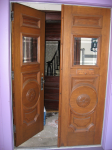
Some more progress photos (as of today, 9/25/08). The exterior of the tower is nearly done. I'm also kind of proud of the little dentil moulding around the porch header that my wife & I made this year. We refinished the front doors three years ago. Perhaps some of the ceiling plaster is visible on the floor.
- Jason
- Jason
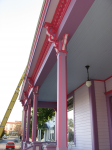
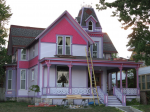


So...I have a question for anyone & everyone. We want to put a hanging light fixture up in the tower, but I'm not entirely sure what sort of fixture would be most appropriate. For example, would a pull-down kerosene "hall lamp" be best?...or a brass pendant or chandelier?...or a fancy hanging parlor lamp? Regardless of the type of fixture, we will need something that has been electrified.
The floor space is a little bigger than 7'-square (nice for a recamier, some books, and maybe a small flat-screen tv if I go crazy...or high-power rifle <jk>). The ceiling, once installed, will be nearly 11' high. The walls taper in towards the ceiling (the ceiling probably being a little under 3'-square). Depending on the fixture, the bottom might be more visible than the sides.
Any thoughts as to what would be "appropriate" for a tower room?
- Jason
The floor space is a little bigger than 7'-square (nice for a recamier, some books, and maybe a small flat-screen tv if I go crazy...or high-power rifle <jk>). The ceiling, once installed, will be nearly 11' high. The walls taper in towards the ceiling (the ceiling probably being a little under 3'-square). Depending on the fixture, the bottom might be more visible than the sides.
Any thoughts as to what would be "appropriate" for a tower room?
- Jason
How about a Fresnel light for the tower? :D
I'm no expert, but I own a few period lights so here's my thoughts:
There was a lot of overlap in gas/electric from the 1880s through the early 1900s. It wasn't practical for a home to convert over to electric lights until 1913 from a mainstream standpoint, but there are electric-only fixtures from the 1880s. You can find a lot of gas/electric combination lighting during this time as well. So, to be truly period for your home - when it was built, gasoliers are probably the best choice.
A 3 or 4 light gasolier chandelier, electrified, is a good option. Anything more than 4 lights might be overkill for the 7' diameter room. The attached image is an example. Since we're talking gasolier, by default, the configuration will include a rod - not a chain - you need a path for the gas to travel. You might be able to find one with a long enough rod, but a chain can be adapted to a cut-down rod as you see in the image. I had my 1880s gasolier's rod lengthened by a professional, which is always an option.
A single-bulb pendant lamp might not illuminate the room fully, but you might get by. You can find 2-light pendants that were gas/electric combos (one up, one down) converted to be both electric. You might get by with that, illumination-wise and it might work fairly well for a tall and narrow room due to the projection of light in both directions.
Another option is to get 2 or 4 sconces (single or double-arm), which might be easier to wire and install than one heavier light 11' in the air. It would be challenging and expensive to find 3 or 4 matching antique sconces. Two would be fairly easy to locate, but more would be a challenge. Reproductions that would look appropriate and are cost-effective are here.
If you want a truly period lamp (or sconces), auctions are the way to go. It may take time to wait for the "right" one to pop up, but buying good antique gasolier lamps retail can be expensive for a "finer" one.
I'm no expert, but I own a few period lights so here's my thoughts:
There was a lot of overlap in gas/electric from the 1880s through the early 1900s. It wasn't practical for a home to convert over to electric lights until 1913 from a mainstream standpoint, but there are electric-only fixtures from the 1880s. You can find a lot of gas/electric combination lighting during this time as well. So, to be truly period for your home - when it was built, gasoliers are probably the best choice.
A 3 or 4 light gasolier chandelier, electrified, is a good option. Anything more than 4 lights might be overkill for the 7' diameter room. The attached image is an example. Since we're talking gasolier, by default, the configuration will include a rod - not a chain - you need a path for the gas to travel. You might be able to find one with a long enough rod, but a chain can be adapted to a cut-down rod as you see in the image. I had my 1880s gasolier's rod lengthened by a professional, which is always an option.
A single-bulb pendant lamp might not illuminate the room fully, but you might get by. You can find 2-light pendants that were gas/electric combos (one up, one down) converted to be both electric. You might get by with that, illumination-wise and it might work fairly well for a tall and narrow room due to the projection of light in both directions.
Another option is to get 2 or 4 sconces (single or double-arm), which might be easier to wire and install than one heavier light 11' in the air. It would be challenging and expensive to find 3 or 4 matching antique sconces. Two would be fairly easy to locate, but more would be a challenge. Reproductions that would look appropriate and are cost-effective are here.
If you want a truly period lamp (or sconces), auctions are the way to go. It may take time to wait for the "right" one to pop up, but buying good antique gasolier lamps retail can be expensive for a "finer" one.
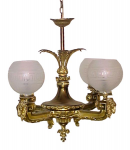
Nice fixture...too bad the asking price is $8,000. I'll spend some more time thumbing through my vlworks catalog. Sconces are out given as that the walls slope inward beginning at knee-height and each of the four walls have a relatively large window.
I wonder what was there originally. Given as that the owners weren't rich, I wonder if they had anything...or maybe a cheap-ish kitchen pull-down kerosene lamp. I haven't some across pictures of light fixtures for towers just yet. Indeed, if I come across a cheap gasolier I might jump at it...those are very pretty.
Thank you,
Jason
I wonder what was there originally. Given as that the owners weren't rich, I wonder if they had anything...or maybe a cheap-ish kitchen pull-down kerosene lamp. I haven't some across pictures of light fixtures for towers just yet. Indeed, if I come across a cheap gasolier I might jump at it...those are very pretty.
Thank you,
Jason
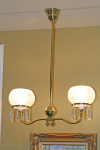
Yeah, but ignore that price due to who it is being sold by - they have good stuff, but always at top dollar. You can find similar gasoliers for a fraction of that. I got a two-arm, electrified brass gasolier with globe shades (original) for a few hundred (don't remember). See attached.
Another option are those brass piano lamps - tall floor lamps. Many of those have been electrified over the years.
Another option are those brass piano lamps - tall floor lamps. Many of those have been electrified over the years.
We had a bit of an ice dam issue in early January with the new roof...specifically, where it meets up with the new tower. The details of this story are long and boring, but we ended up jumping into a "bonus" attic insulation project. The only access into the attic was through a 12"x18" hole in the back hall situated in way of where the roof meets a wall (the troubling issue here being that the roofing nails tend to hit flesh whenever you transit through the hole). We now have a new 24"x24" in the front stair hall. All of the old rock wool was sucked out of the attic and replaced with a foot or so of blown-in cellulose and spray-on foam in certain strategic areas. We also had a number of holes drilled into the plaster walls in that front hall so as to blow some insulation into those walls. The wiring in the attic was inspected and replaced wherever necessary. The plaster folks came out and finally put some nice walls inside the tower, patched the holes in the hall walls, and fixed up the ceiling in the front entrance foyer.
Anyway, the front stair hall is still a bit of a mess. The 1920s-era wall & ceiling paper was no good to begin with, but now it is really trashed (I stripped most of the ceiling paper and anything on the walls where holes needed to be patched). I think that we are going to order some nice wallpaper for the foyer soon (leaning towards either the Wolff House "Dixon" pattern or the Mason & Wolf "Osaka"), but we probably won't get around to doing the tower until the coming winter (I'm loving the Carter & Co. / Mt. Diablo "shooting star" paper for the steeply-pitched ceiling/walls in the tower, but still not sure what to do down low for a dado). The front stair hall will probably have to wait for another couple of years. Oh well. ...and we still haven't selected a hanging light fixture for the tower, but I keep looking for a nice electrified pull-down kerosene-type thing.
Our big front parlor window (roughly a 6' tall x 5' wide plate, I think) took a BB shot from a vandal this winter. We need to replace the glass some time soon.
Anyway, things have kept us busy here (to say nothing of our two-year-old and day jobs).
- Jason
Anyway, the front stair hall is still a bit of a mess. The 1920s-era wall & ceiling paper was no good to begin with, but now it is really trashed (I stripped most of the ceiling paper and anything on the walls where holes needed to be patched). I think that we are going to order some nice wallpaper for the foyer soon (leaning towards either the Wolff House "Dixon" pattern or the Mason & Wolf "Osaka"), but we probably won't get around to doing the tower until the coming winter (I'm loving the Carter & Co. / Mt. Diablo "shooting star" paper for the steeply-pitched ceiling/walls in the tower, but still not sure what to do down low for a dado). The front stair hall will probably have to wait for another couple of years. Oh well. ...and we still haven't selected a hanging light fixture for the tower, but I keep looking for a nice electrified pull-down kerosene-type thing.
Our big front parlor window (roughly a 6' tall x 5' wide plate, I think) took a BB shot from a vandal this winter. We need to replace the glass some time soon.
Anyway, things have kept us busy here (to say nothing of our two-year-old and day jobs).
- Jason
If you are having a problem w/ ice damming behind your tower, you might want to consider installing a "Cricket" to solve the problem - like what is used behind chimneys to divert the rain & snow around/ past such obstacles as is shown in the picture here: http://tinyurl.com/dxs2us