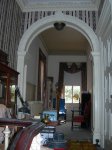
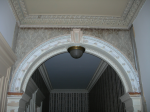
Started by misslilybart · July 26, 2008 · 27 posts · 36 images
Archive summary
Victorian Homes & Buildings thread on victorianforum.com · started July 26, 2008 by misslilybart · 27 posts, 36 image attachments · discussion in 2008.
Since the board focus is primarily on American Rococco and Renaissance Revival furniture, as an Aesthetic Movement/Reformed Gothic kind of girl I generally have nothing of worth to contribute. Decorated ceilings, on the other hand, are something I do know about! Thanks for…
Since the board focus is primarily on American Rococco and Renaissance Revival furniture, as an Aesthetic Movement/Reformed Gothic kind of girl I generally have nothing of worth to contribute. Decorated ceilings, on the other hand, are something I do know about! Thanks for introducing the topic, woodwright! :)
I wish I could take credit for the design of these rooms, but my husband is 99% responsible for the planning and execution... they are all a combination of commercially available papers and hand stenciling.
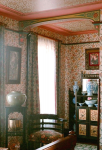
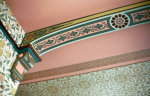
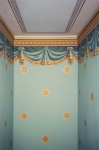
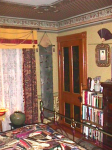
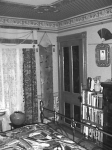
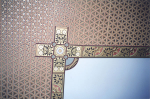
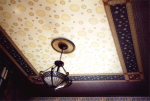
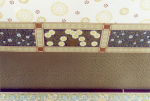
Top to bottom:
The English Arts and Crafts Movement bedroom is Sanderson's Wm. Morris "Fruit" sidewall, and Bradbury & Bradbury's "Morris Ceiling" in what I think is a custom coloring (?). The alcove archway with plaster corbels is stenciled with (IIRC) designs by the Audsleys, and yes the ceiling border really is salmon pink!
The cobalt pistachio green room is a rear "service staircase" that we have "imagined" as being from the 2nd quarter of the 19th century (or about 75 years before the house was built). The only "ready made" element is the swagged trompe l'oeil frieze (Schumacher, maybe?); all else including the powdered wall design were stenciled.
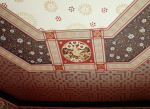
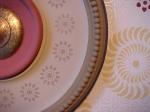
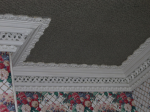
The Anglo-Japanesque bedroom is a work in progress and I regret I have no proper photographs of it. Just as we've never settled on just exactly what to hang on the walls or which tchotchkes to display, the ceiling was "revised" after an number of years with the addition of a stenciled inner border - the detail shows v.1; the room view, v.2, the b&w room view is an example of the "desaturate a color photo to check whether the room 'reads' as period or not" trick.
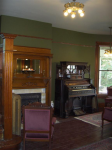
This room was probably either a dining room or rear parlor, and is our library, thanks to the miracle of the custom built floor to ceiling bookcase! The sidewall and dado are store-bought from one of the Victorian wallpaper collections that were available 10 or 15 years ago Katzenbach and Warren's Philadephia Athenaeum collection, the frieze is a Walter Crane design from Bradbury, and the dado border was hand-stenciled (by that wonder of a husband I mentioned earlier) on blankstock, to coordinate with the frieze. The doors were hand decorated in homage to Whistler's Peacock Room.
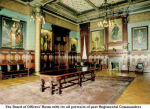
The ceiling (which is what this is all about) was inspired by Christian Herter's design of the Board of Officers Room at the Seventh Regiment Armory. The papers on the ceiling were all hand-stenciled on blankstock, with the exception of the decoupaged bird roundels (a Christopher Dresser design from Bradbury's Anglo-Japanese Roomset) and the ceiling field, which is Bradbury's "Circlet" ceiling with over-stenciled random "pinwheels". B&B's Herter Brothers Roomset had not yet been introduced, otherwise we might well have used that, instead! Again, this room is missing my contribution (the curtains, window hangings and portieres) and I regret I have no proper photographs.
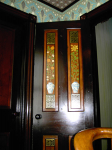
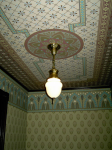
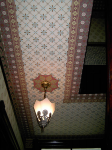
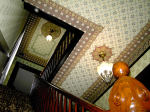
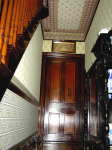
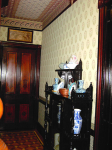
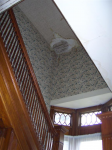
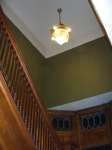
Our current project is the entry stairhall, which is so recent we are still hanging pictures and gluing up furniture for the room. Originally we had planned on hanging a painted and glazed Anaglypta dado, with the rest stenciled in designs by Christopher Dresser. We since have gone into the reproduction wallpaper business, and decided to instead hang papers from our Dresser Collection; the only decorative painting in this room is the floor and the stenciled motifs on the door panels. (We are great advocates of the decorated door... the "potted plant" door is the "inside" of the door to our attic, painted to provide some visual interest when the door is left open for air circulation during the summer months.)
I'll be writing in depth about the work on our entry and stairhall for the next couple of weeks on my blog, The Peacock Room, if anyone is interested in that sort of thing. See my profile for a link to same...
Wow! Great ceilings and papers. I'll bet you've never been accused of being afraid to use color. Very vibrant, bold and dramatic - great choices and placement. Someone has a very good eye. I also clicked your link to the Peacock Room (I see now the namesake of your website). Another wow - I've never seen or heard of it before. Very impressive - next time I'm in Washington, I'll have to see it in person. Pictures rarely do anything justice - if it looks impressive in a flat 2 dimensional photo - it is generally stunning to see in person. Very interesting text and story that goes along with it. My wife loves Peacocks - we have a taxidermied Peacock in our front room - very Victorian. The colors are spectacular up close. woodwright
Quote from: woodwright Wow! Great ceilings and papers. I'll bet you've never been accused of being afraid to use color. Very vibrant, bold and dramatic - great choices and placement. Someone has a very good eye.
Thanks! While we both studied design, late 19th century color theory is a whole 'nother thing. If you study surviving and restored interiors, and follow the decorating advice of the period as published in books and magazines, it's hard to go wrong. The two ideas that nearly every writer emphasized were 'balance' and 'harmony', that everything in an interior should be of equal decorative importance and value is a difficult concept for us (the 21st century observer) to grasp, I think.
I also clicked your link to the Peacock Room (I see now the namesake of your website). Another wow - I've never seen or heard of it before. Very impressive - next time I'm in Washington, I'll have to see it in person. Pictures rarely do anything justice - if it looks impressive in a flat 2 dimensional photo - it is generally stunning to see in person. Very interesting text and story that goes along with it. My wife loves Peacocks - we have a taxidermied Peacock in our front room - very Victorian. The colors are spectacular up close. woodwright
Your peacock is spectacular! We have only feathers, in vases and the like.
Whistler's Peacock Room is well worth seeing. Unless things have changed since we were last at the Freer, visitors are actually allowed in the re-constructed room, rather than standing in a doorway behind a velvet rope. They do not have any furnishings, but it really is about the room as a canvas. (The Freer also has a wonderful collection of paintings and works on paper by Whistler, as well as a large number of works by two other artists I am fond of, Thomas Wilmer Dewing and Abbott H. Thayer).
"Pete" - the peacock came from a taxidermist just outside of Utica NY - the guy does nice work. I don't remember his name - but he exhibits every year @ the Madison/ Bouckville antique show in Bouckville NY (right in the center of town on the north side of Rt. 20)- which by the way is coming up Aug 11-17 (promoted show is 8/16 & 17 - but +/- 1,000 dealers set up the Monday & Tues. before all along Rt. 20. - then another +/- 1,000 Dealers come in for the weekend show - it's our favorite show of the year - we've been going for 20 years. Similar (but different) to the Brimfield show. Google it (Madison Bouckville Antique show 2008) for info if you're in the area - mega worth going to. Everything from crap to world class stuff there and everything in between. I'll pick up one of his cards and post his info on the message board after the show. We saw a peacock for sale years before we got Pete for $400 - but passed it up, then kicked ourselves for not getting it. We then decided we wanted to get one - but couldn't find one that looked good for a fair price - saw a couple for over a grand that looked like they were run over by a truck. Then saw this guy @ Bouckville. He only had all white peacocks @ the show - but had others done @ home (kept frozen in a chest freezer) - we drove 2 1/2 hrs to see him, we had our choice of about a dozen peacocks. Ours stood out from the others - it was the largest and we liked the mount. The price was fair ($400 - came with a simple black perch too - someday I plan to make an elaborate high style perch/ pedestal for him - but that project is still "on the list") - but that was about 10 yrs. ago - don't know what they are today. We love it as much today as the day we bought it/ him. Pete gets lots of comments too. woodwright
Somehow I got it in my head that you were associated with Mason & Wolf wallpapers...am I mistaken?
Presuming that I'm not mistaken, thank you for sending the samples earlier this summer. My wife and I are thinking that we will do our front parlor in the Aesthetic Movement collection in the years ahead.
Regardless of wallpaper, I'm keen to learn more about aesthetic window treatments. I'm familiar enough with the drawings in Dresser's book, but I know nothing about sourcing fabrics & the like. Do you have any advice that you might be willing to share on how to go about making authentic aesthetic movement window treatments? . . . something that would look good in a front parlor that has Mason & Wolf paper on the walls? (we need curtains sooner than we do the wallpaper)
Somehow I got it in my head that you were associated with Mason & Wolf wallpapers...am I mistaken?
Presuming that I'm not mistaken, thank you for sending the samples earlier this summer. My wife and I are thinking that we will do our front parlor in the Aesthetic Movement collection in the years ahead.
Regardless of wallpaper, I'm keen to learn more about aesthetic window treatments. I'm familiar enough with the drawings in Dresser's book, but I know nothing about sourcing fabrics & the like. Do you have any advice that you might be willing to share on how to go about making authentic aesthetic movement window treatments? . . . something that would look good in a front parlor that has Mason & Wolf paper on the walls? (we need curtains sooner than we do the wallpaper)
Thank you,
Jason
Jason,
Yes, I am the "Wolf" in Mason and Wolf. I'm glad you liked the samples, and as they said back in the 19th century, "we look forward to your commerce." If you have any questions, drop us an e-mail. :)
I can indeed provide some advice regarding Aesthetic window treatments. Let me gather my thoughts and pull together some illustrations and references... it is a topic that I take particular interest in and I want to do it justice!
Quote from: Rare Victorian Please do share on the window treatments. I'll post pictures of mine once they're in (coming soon...), but always interested in a more educated voice.
My voice is self-educated, I fear... I am working on a response, and it will be forthcoming, but I am still looking for the public-domain images to illustrate my points.
Quote from: 1881victorian Gotta say...I keep checking here every day in my super-anticipation mode...I'm very excited to read up on curtains! No rush though...just excited!
- Jason
I apologize for the delay, Jason. One of our computers had a bad hard drive, and of course it is the computer with the scanner attached. So I've been backing up, rebuilding and reloading and replugging... Rest assured, "Aesthetic curtains" is next on my to-do list! :)
We have several books on curtains and window treatments. The one I think is the best (at least of what we have - or anything I've seen personally) is "The Curtain Book" by Caroline Clifton - Mogg and Melanie Paine. Bulfinch Press - copyright 1988. Don't know if it's still in print or not. It has quite a few colored drawings of high style Victorian window treatments. Nice drawings in full color w/ nice details & trims - very inspirational & worth owning. I don't know enough about interior design/ periods to say which (if any) are aesthetic style treatments. I just did a search for it - there are many available - some for less than $5.00 including shipping! Don't think cheap means poor - not the case here - I assure you. Here is the review page from Amazon for it. http://www.amazon.com/review/product/B000FILLLY/ref=dp_top_cm_cr_acr_txt?%5Fencoding=UTF8&showViewpoints=1 Search for book: http://www.bestwebbuys.com/The_Curtain_Book-ISBN_9780821221945.html?isrc=b-search (2 in ebay stores $9 & $13.00 + S&H) woodwright
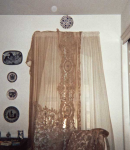
I get a lot of people writing me to sell me antiques, etc. Coincidentally I recently received this photo of some Victorian lace window treatments - apparently authentic late 19th century. They need a major cleaning and I'm not usually a lace person, nor is my wife, so doubt I will move on them. Thought I'd share a photo of one of the panels draped (not properly hung) over the sellers permanent drapes.
I forgot to respond to one comment at the top by Misslilybart: "Since the board focus is primarily on American Rococco and Renaissance Revival furniture, as an Aesthetic Movement/Reformed Gothic kind of girl I generally have nothing of worth to contribute".
If that seems to be the case, it is purely by accident. The styles you mention are just less in the spotlight than the others, so it just naturally happens. We love to hear about it all so please don't hold back.
Great photos! We are planning on doing our ceilings and these gave me some ideas. We had a friend who is very talented and went thru bargain bins at local wallpaper stores and came up with some beautiful ceilings without a lot of expense, and he used computer software to create his designs.
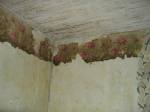
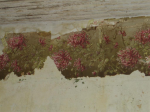
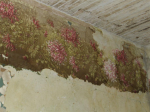
My wife and I have been restoring a 1901 Queen Anne Victorian with extensive interior damage. Some of the rooms were untouched and had original wallpapers and borders. We saved samples of all the wallpapers and borders and my wife made stencils before we removed them. Our Parlor (I believe more properly called the Entry Hall) had a wonderful 18" frieze of chrysanthemums? (see photos below) from the Geo. Halbert wallpaper company. We'd like to reproduce this frieze, but haven't had luck finding someone to do it.
Misslilybart - In an earlier post, you mention hand stenciling on blackstock:
Quote from: misslilybart ...and the dado border was hand-stenciled (by that wonder of a husband I mentioned earlier) on blankstock, to coordinate with the frieze...
Where does one obtain blackstock, what "paint" do you use to color it, and how is it hung (same process as normal paper?)?
Now that I've finished the plaster work and painting, we're excited to have the frieze - you can tell by the after pictures that there is an obvious blank spot in the stairway and above the picture rail where it will go!
Where does one obtain blackstock, what "paint" do you use to color it, and how is it hung (same process as normal paper?)?
First, let me clarify that "blankstock" is shorthand 'round our house for what would more properly be called "ungrounded blank wall paper stock"... We purchased the paper my husband used to create our library from a friend who was in the business at the time, the stencilling was executed in ordinary latex paint, and it was hung in the usual way, with whatever paste you would normally use for a handprinted wallpaper, this according to my husband.
As to sources for obtaining stock today... when Bruce Bradbury was still at Bradbury and Bradbury, they would sell the same grounded papers they print on (and presumably, plain white ungrounded paper). I'm not sure what their current policy is, though.
paper-hangings.com sells a blankstock (as opposed to "ungrounded blank wall paper stock"), which is lining paper used underneath wallpaper to provide a "softer" surface and better adhesion. Blankstock lining paper is not what we used for our stencilled wallpaper.
And I apologize if my imprecise terminology caused any confusion. :-[
Quote from: 1881victorian Gotta say...I keep checking here every day in my super-anticipation mode...I'm very excited to read up on curtains! No rush though...just excited!
- Jason
With apologies for the lo-o-o-o-o-ong delay, I've posted some info on Aesthetic curtains under its own subject heading.
HiMissLilyBart I have painted ceilings in my 1862 Italianate, (see My Italianate in Salem post for lots of photos) but subsequent renovations have laid full sheets of the "wrong" wallpaper on the ceilings. Looks horrendous! I found some wall paper behind our huge pier glass over the fireplace that is a metallic gold moire with a very 1900's looking pattern tone on tone. I will try and locate the scans and attach to this message. Could the whole room have been gold wallpaper?!!! seems really overwhelming considering the amount of gold leaf and color used in that parlor cornice and other plaster work. This room's walls has been subsequently painted, so I am painting not wallpapering. Other rooms in house have bare plaster that has never been painted, so I am loathe to ruin that beautiful smooth feeling with paint. So will wallpaper where needed, but am having a hard time finding earlier treatments circa 1860 for the ceilings in papers. The William Morris stuff seems too late, too modern and too busy considering the ornate plaster cornice work and huge medallions. We have dated the last paint work to 1881, I found the signature and date of the local that did the ceiling on top of one of the door moldings...so am unsure of what paint to pursue, the 1881 work or the 1862 work which is less colorful. Attached you will see the foyer ceiling paint that was under the overpainted white. We think this is circa 1867, but there are multiple dates on the ledge where they signed their work.
Can you advise what to do about ceiling wallpaper that would be an earlier treatment, less victorian and won't compete with the beautiful plaster work?
Quote from: amadara HiMissLilyBart I have painted ceilings in my 1862 Italianate, (see My Italianate in Salem post for lots of photos) but subsequent renovations have laid full sheets of the "wrong" wallpaper on the ceilings. Looks horrendous! I found some wall paper behind our huge pier glass over the fireplace that is a metallic gold moire with a very 1900's looking pattern tone on tone. I will try and locate the scans and attach to this message. Could the whole room have been gold wallpaper?!!! seems really overwhelming considering the amount of gold leaf and color used in that parlor cornice and other plaster work. This room's walls has been subsequently painted, so I am painting not wallpapering. Other rooms in house have bare plaster that has never been painted, so I am loathe to ruin that beautiful smooth feeling with paint. So will wallpaper where needed, but am having a hard time finding earlier treatments circa 1860 for the ceilings in papers. The William Morris stuff seems too late, too modern and too busy considering the ornate plaster cornice work and huge medallions. We have dated the last paint work to 1881, I found the signature and date of the local that did the ceiling on top of one of the door moldings...so am unsure of what paint to pursue, the 1881 work or the 1862 work which is less colorful. Attached you will see the foyer ceiling paint that was under the overpainted white. We think this is circa 1867, but there are multiple dates on the ledge where they signed their work.
Can you advise what to do about ceiling wallpaper that would be an earlier treatment, less victorian and won't compete with the beautiful plaster work?
amadara,
As my interest is primarily the decor of the "fourth quarter" (1875-1900) with a corollary interest in the American Art and Crafts Movement into the early 20th century, I hesitate to offer any opinions regarding your ceiling decoration dilemma. I have passed your query on to my husband, who is much better versed than I, and will convey his thoughts once he's gotten back to me. (And hopefully some of the board participants who have a special interest in Rococo and particularly Renaissance Revival decor will share their knowledge!)
I can address the gold wallpaper, however. It probably dates from between 1880-1910. The principal foliate pattern is reminiscent of the designs of C.F.A. Voysey; a secondary moire pattern would indicate that the paper was intended to mimic watered silk fabric. Metallic and reflective wall and ceiling papers were very desirable and fashionable throughout the last decades of the 19th century, and it would not have been unusual for such papers to be used on both the walls and ceiling of a room. (See my earlier post on Aesthetic curtains for Catherine Lynn's almost poetic explanation of this use of metallics, as she explains it in words far more eloquent and evocative than any at my disposal.) In the lower light levels that would have been present in an interior of that period, the metallics do not "jump out" as bright and shiny... rather the light plays across the surface, highlighting some areas, creating subtle gradations of color with the positive and negative spaces of a pattern "shifting" according to the position of both light source and viewer. (We have several rooms in our home decorated with period-appropriate papers, and I can personally attest to the visual interest provided by metallic/reflective surfaces, in both natural and artificial light.)
Thanks for the help in IDing the wallpaper. I thought it looked too recent for the original decoration. Your comment was helpful, and I am following a lot of sources for ceiling decoration, so if you think of anything be sure to post me. THX
Quote from: amadara Thanks for the help in IDing the wallpaper. I thought it looked too recent for the original decoration. Your comment was helpful, and I am following a lot of sources for ceiling decoration, so if you think of anything be sure to post me. THX
amadara,
You might want to take a look at the images RareVictorian has linked to in his post here. Constructed between 1863 and 1865, the Henry Lippitt house is a rare extant example of high style Renaissance Revival interior decoration. The Morse-Libby House is another, its interiors were designed by Gustave Herter. Color images here; HABS documentation here.
This is Wayne from Mason & Wolf. Cheryl answered some of your questions and pointed you to the Gov. Lippitt and Morse-Libby houses, which are the same time period as your house and compare well. First, the painted decoration in your house is extraordinary. It merits proper documentation in its current state. The good news is: it is spectacular. The bad news is: spectacular is neither easy nor inexpensive to conserve/restore. This kind of intact decoration, no matter how damaged, requires that you tread softly and take your time. It also requires some evaluation by experienced experts. This is not a job to be attempted by amateurs or tradespeople with modest skills. I would contact the NJ Historic Preservation Office www.state.nj.us/dep/hpo. Every state has a HPO. They will understand the significance of your historic interior decoration and can offer guidance. There are firms that specialize in painted decoration like yours. John Canning is just one who comes to mind: www.canning-studios.com. There are also historic preservation consultants that can assist. Gail Winkler also comes to mind. She is just across the river in Philadelphia 215-925-8367. Understand that there are other folks who do this kind of work; Canning and Winkler are just two of the many experts who have excellent resumes.
BTW - Your house was recorded by the Historic American Buildings Survey. Just Google HABS and search for the William Sharp house in Salem, NJ. There's one exterior photo and a short description of the exterior. Nothing on the interior though. Rats!
On to wallpaper. You have good instincts. Bare plaster (never painted) is almost certainly evidence that wallpaper was hung at one time. No Victorian would have lived with bare plaster walls anymore than we would roll out the carpet and move in the sofa after the sheetrock was taped and spackled. You are right. William Morris is not right for your house. Finding period appropriate wallpaper will take some time and dedication of funds. To start, look at what was manufactured in the 1860s. There's a number of books on historic wallpaper that can be found in better libraries. You are lucky; The Athenaeum of Philadelphia is close by and they have a huge library dedicated to all things 19th century. Plan to spend a whole day there - you will still be roaming the stacks when they tell you it's closing time.
OK, reading about historic wallpaper (and looking at the pictures) will tell you what you could buy in 1862, but what can you buy now? I would get a copy of Fabrics and Wallpapers for Historic Buildings by Jane and Richard Nylander. This is the only book that is completely focused on what is being reproduced today. More manufacturers have entered the market since this book was published and more paterns are being reproduced every day - best to contact the manufacturers to find out what they have to offer for your time period.
Now, let's look at the givens. Your house is Italianate and the plasterwork is classical/rococo. That is consistent with what was being bult in that time period. The house appears to have been spared heavy remodeling - doors, windows, plasterwork, woodwork, wall treatments, and glass appear to be mostly intact and of the same period.
Your photos of the vestibule show wonderful classical motifs on the walls, not unlike some of the French wallpapers from the first half of the century. The ceiling decoration complements and repeats the classical decoration on the walls. Makes sense, right? An Italianate house would look to Rome and the ancient classical world for inspiration.
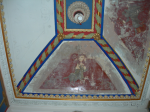
Another photo shows a stunning paint-decorated ceiling. It is quite elaborate and would have cost a pretty penny in the 1860s. I suspect that the work was done by highly-trained decorative painters operating out of Philadelphia. They advertised as "fresco painters" although the technique is not true fresco.
The close up photo of the plaster cornice (same room?) shows how the color and goldleaf highlights used to decorate the ceiling would be carried down to decorate the plaster encircling the room.
In all likelihood, all of the fist floor rooms (the public spaces in the house) would have been decorated with the same degree of sophistication. Which makes me wonder about the photo of the light fixture and plaster ceiling medallion. I bet that medallion got the polychrome treatment and there is painted decoration under the white paint. Likewise, the photo of the room with the rose trellis wallpaper makes me wonder what is hiding under... what is that? Is that a wallaper with a burlap design or grass paper? Ceilings were often papered-over to hide the cracks. Depending on what material it is and what adhesive was used, it may require some special care and a little experimentation to remove it without damaging the ceiling underneath.
From what I can see in the photos, all of the old decoration appears to be of the same style and time period - mid-century. It was probably executed shortly after the house was constructed. Workman signatures can be difficult to puzzle out. Sometimes a later date and signature is from a touch up job, rather than a complete redecoration. That's what I suspect. I don't see the 1881 date as being new work, although classical motifs were constantly being revived.
You will find that painted ceilings are more prevalent than ceiling papers in the mid-century - your house seems to fall in with that trend. In the past thirty years some mid-century wallpaper borders and corner elements have been reproduced, but I don't know if they are currently available. As far as wallpapers, take a cue from the wall decoration in the vestibule. There are several designs from the mid-century that employ classical motifs that have been reproduced (see Nylander). You don't have to "go classical" in every room, since Victorians liked to "mix it up", but you do need to stick to the time period and key the decoration to the ceiling. Some Renaissance patterns and Elizabethan damasks play well with classical design.
Maybe more information than you asked for, but I think your house deserved more than a short answer. I hope I answered some of your questions. I think you have a great house and the surviving decoration is precious. I hope you can manage to bring it back. I am always interested in historic interiors and will try to answer any questions you may have.
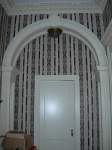
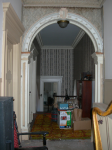
Sorry Wayne and MissLilyBart: I have been working my little fingers to the knuckles on the house, so typing has not been high on the list. But, wanted to respond for all your kind assistance now that I have a rainy day inside. I had found the HABS quite a while ago. Even that photo is not very good! but at least it is up there. The house is also included in the "Market Street Historic District" part of the NJ Historic Pres Office. The reason there is no info on the interiors on either of these sites is that my in-laws have owned the house for the last 60 years. It was used as my FIL doctor office and the horrific renovations to accommodate that usage were done in 1948. I have tried to get Gail Winkler and Roger Moss to come, but they are too busy as they say. They know a number of people in the neighborhood and I have enlisted them to also plead the case. No results yet. I also dont think we can afford that type of assistance currently, so I am researching and restoring. I might want to get some interns from the U0fP program and maybe they could use the work for credit providing stipend and materials. Hmmm... so much to do! I scored Gail's reports from the Union League historian, so some of my research has come right from the source, although I wish she would come and provide site specific. Currently I am casting all of the plaster repairs which means I am heavily invested in the mold making rubbers, silicons and polys. I was able to score some molds from my friend David Flaharty that he had in his portfolio from a repair he did in New Orleans, so have been casting a bunch of those every weekend in order to send the materials back to him in a month or so. I have visited the Athenaeum when I was looking for architect. I have a couple of leads, but they are relatively unknown builders turned architect. I also have a suspicion that our owner was heavily involved because there are some instances in wall lengths and facing doors that are not quite aligned or symmetrical. My painter history is quite interesting. When I was in Maine, I visited Victoria Mansion trying to get some paint attribution. While there, I met with curator and she advised me to look local. I had been all over the Philly painters and had not met with success. Also a painter in Salem exhibited at Centennial exhibition in Philly (thought I would score with that, but no luck) Finally found the signatures while cleaning the ledges over the windows. The foyer was painted by William Penn Chattin, who owned the local painting company in Salem. Salem was a big city back then, and a suburb of Philly connected first by Steamboat, then by Rail. His work dates from the 1866-69 period. He is married to the owner's (Sharp) cousin. The second signature is in the large parlor also on a ledge. It reads "Painted Murals 1881 by W. N. Davis". Davis at one time worked for Chattin. He and his wife lived on the small street behind our house with another family in a house owned by Chattin. Davis was married to our owner's sister!, but by 1881, we are on to the third owners of the house, so the rich farmer turned banker who married the much younger and wealthy 2nd wife are the ones responsible for his pay. The painting happened soon after the wedding, so of course the new wife wanted to redecorate and she had as much money as her husband. I call her "the rich widow". As you can tell, I have boxes of research on all owners, their relationships and the town at the different time periods. Also a ton of comparable decorative research, but as you said, finding manufacturers of papers and carpets that are available now and work with the decoration is difficult. I did stumble upon Farrow & Ball, and another site where I liked the papers, but I fear, I am months out from doing the work. My MIL wallpapered the ceiling in the rose room to cover the cracks. I am removing that now, so I can repair the cracks and see if there is paint decoration. This is the last of elaborate rooms on 1st floor. The back parlor has no cornice, (probably removed) and a badly broken medallion that I am currently casting the pieces for repair. Kitchen has no other decoration. We are also missing a myriad of exterior details on the portico roof and the cupola roof. The brick outhouse has its medallion missing a couple of shells, so a very easy repair. Upstairs, The rooms follow the same pattern. The hallway has a beautiful columned arch that we removed the added wall to open up. I have attached photo for you here. The two bedrooms were wallpapered and I have removed to find no painted decoration on ceilings, but the two bedroom cornices and medallions are unique and in good condition. I find gold under the paint that is chipping off, but unfortunately, the gold is not sticking to plaster, but to the subsequent paint that is falling off as chips. (Dont make me curse my inlaws in public!) I have a chimney wall cornice that suffered water damage in both rooms that I am repairing now. The center room is accessible by front and back stairs and has a plain almost wooden looking cornice, but a great medallion. The current bath might have been a rented room at some time and the back bedroom was originally a servants room accessed by stairs to kitchen. Those two rooms are undecorated. The walls were definitely all paper upstairs. Removal shows the beautiful smooth white plaster that you would expect. I wanted to Toile the bedroom I'll be sleeping in, but I think that might be too federal? I will look at the sources you provided and keep you in the loop. There is a great wallpaperer in town that I want to use, he has been there forever and does a great job, but I need to bring him the paper, know what I mean? THANKS FOR ALL YOUR HELP. SORRY FOR DELAY IN REPLY, I AM SOOOOO BUSY WITH WORKING ON THIS!