Hi All,
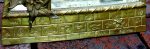
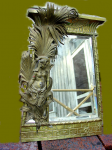
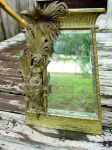
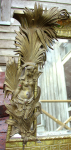
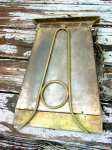
Since I was doing some cleaning out over the weekend and happily "re-discovered" an Egyptian Revival mirror I had stashed away in an antique wardrobe a decade or longer ago, thought I would take a couple of photos to share. The only identifying marks are in the lower left hand corner of the front where there is a "v..i..i" or something about like that. Given that the mirror is beveled doubtful it would date before 1880 and it could even be as late as 1890's. It is very heavy and the applied figural ornament appears to be cast iron with applied gilded paint. (someone also dabbed on a bit of red in a couple of places long ago) The support rod on the back also seems "Egyptian" and somewhat symbolic as well. It was bought at auction for about $40 a decade ago. It is also the only Egyptian Revival piece I have. I wonder if it would work in a Moorish style room?
Egyptian Revival Mirror
Archive summary
Other Antiques thread on victorianforum.com · started May 16, 2010 by vintrest · 5 posts, 5 image attachments · discussion in 2010.
Hi All, Since I was doing some cleaning out over the weekend and happily "re-discovered" an Egyptian Revival mirror I had stashed away in an antique wardrobe a decade or longer ago, thought I would take a couple of photos to share. The only identifying marks are in the lower…
I'm not helpful here, but back in college I took an elective on Egyptian hieroglyphics. I can safely say that I forgot nearly 100% of what I "learned" in that class (I remember things like "ha ptah maat", among other useless phrases). Some of the glyphs on the bottom of the mirror do appear to be based on the real stuff. You might consider trying to determine if the glyphs on the mirror spell out something if read phonetically. I'd have to do some digging to find my textbooks, but, if I happen to come across them, I'll take a second look here. (My hunch is that the symbols on your mirror have no real basis in anything intelligible, but stranger things have come up)
- Jason
- Jason
I never even considered that possibility. I know the Victorians had a whimsical sense of humor so it would not surprise me in the least to learn the symbols had some covert meaning. Greek and Latin were almost mandatory at all institutions of higher learning during the 1800's compared to today when many of our college age youth cannot even read, write, or spell English intelligently. Please let me know if you decipher any meaning from the glyphs. I can post a larger version of the symbols if that would be of any help.
John
John
A better photo of just the glyph section might be handy. I may be able to find my old prof and just send it to him as a "hey, can you take a look?".
Thank you,
Jason
Thank you,
Jason
Ok, hope this will work. Please let me know if this actually makes any sense. Thanks, John