Who made this Victorian Desk?
Archive summary
Antique Furniture Attributions thread on victorianforum.com · started February 14, 2009 by Alley Antiques · 24 posts, 6 image attachments · discussion in 2009–2013.
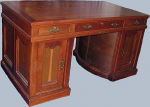
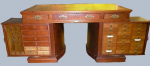
We recently purchased an interesting Victorian desk. Thought it might be fun to see if anyone could guess the maker. I do know the maker as the desk has a makers label. I will throw some clues your way. This is a Victorian double pedestal rotary desk. Dates to the 1880s. It…
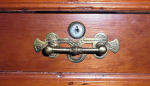
We recently purchased an interesting Victorian desk. Thought it might be fun to see if anyone could guess the maker. I do know the maker as the desk has a makers label. I will throw some clues your way. This is a Victorian double pedestal rotary desk. Dates to the 1880s. It is made of solid cherry (refinished). It was made in North America. Top drawers are hand dovetailed. Has original drawer pulls. 3 drawers over 2 rotating cupboards. Each cupboard fitted with drawers. Do you know who made this? One last clue: it was not made by Wooton.
Stumped me. Thanks for posting it.
how about moore?
stever
stever
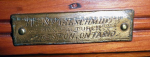
It is not Moore. To tell the truth, I had never heard of this Company until I stumbled upon this desk. When I first saw the desk, I thought it was by Wooton. Then I saw the brass manufacturers tag. I did some research and found out that this company made a flat top rotary desk, and shortly after that they made a roll top version rotary desk, along with other office and school furniture.
It's Canadian - Stahlschmidt
Hardwood is correct. The desk was made by William Stahlschmidt Preston Ontario, Canada. Preston is now called Cambridge. W. Stahlschmidt started business in 1884. By the early 1890s it merged and became the Canadian Office and School Co. I thought it was interesting how similar their desk is to the Wooton rotary desk. Wooton had a patent on the rotary desk. Wooton's business was winding down by 1884 or 1885. Did the patent run out? Did Wooton give Stahlschmidt permission to use the patent? Did Stahlschmidt make the desk in spite of the patent? I have no idea, but it makes me curious.
I wonder what International observance of U.S. patents was at the time.
Quote from: Rare Victorian
I wonder what International observance of U.S. patents was at the time.
I know nothing of the mysteries of patent law, and even less of utility patents (which would apply to the desk under discussion). With regard to design patents, however, there was apparently no international recognition of those rights in the late 19th century.
Dr. Christopher Dresser zealously guarded his designs, and complained of the American "knock-offs". The wallpaper patterns he licensed to an American manufacturer were patented in the United States, which, while not unheard of, was relatively unusual. A few English wallpaper concerns (Woollam's, for example) even registered some wallpaper patterns in both the US and UK to avert "design poaching," something that presumably would not have been necessary had there been any international patent law in force.
Does the applicable Wooton patent claim reference the mechanical aspects of the desk's operation, or is it a more general patent such as "a desk with rotating columnar compartments"?
I just found a great Smithsonian Institution article on Wootons timeline and patents. It mentions about Wooton : "The 1876 catalog warned against patent infringements, and one wonders if that word of caution was unheeded by firms in Indianapolis and Richmond, Indiana; Cincinnati, Ohio; and Preston, Ontario, that proceeded with Rotary Desks and variations on the basic Wooton theme. Perhaps Wooton sold his patent rights, or possibly the desks of these firms were sufficiently different to be innocent of patent violations.One lawsuit over the Rotary Desk design did occur in England in May 1876 between Wooton's representatives and the makers of the Royd desk; the court ruled in favor of Wooton."
This thread is pretty old but I hope that some of the participants are still active in this lovely, new-to-me forum. Many years ago, I inherited a black walnut cylinder-pedestal rolltop desk, which I want to believe was made by the Canadian W. Stahlschmidt & Company. However, the faithfulness by which that Preston, Ontario firm copied the Wooten model, made in Indianapolis about ten years earlier, leaves me unsure. I've read the exhaustive Wooten history published by the Smithsonian Institute in the late 1960s but I have never seen another example of either maker's work in person. I did learn recently that there's an unattributed example just a weekend journey from my home. I will make the trip soon.
My desk was brought to western Canada by my grandfather, who moved from southern Ontario in 1928. The structure was partially repaired at some point, probably due to reclimatisation in the dry prairie air. The base of the desktop insert was replaced with plywood and a black leatherette cover was installed. An embossed, Greek Key border partially remains of the original insert. The rest of the desk appears to be original and has survived in fine, well-used condition.
The built-in accessories and some decorative details of my desk differ from the photos of several others that I've found on the Internet. Principally, the base panels of mine are plain molded, with the centres set with gorgeous thick veneers of burled walnut. They don't have the partly-routered frame edges and carved top half-medallions that appear on all other examples I've seen, including the one presented here by Alley Antiques in February of last year.
The document cases in the cylinder wings are also different from those on Alley Antiques' piece. The left side has 4" square, open-ended, slide-in boxes, presumably sized for rolled sets of contracts. Up the centre are shallow flat drawers that are a bit too narrow for modern letter-size paper. The right wing has horizontal and vertical filing slots, similar to the far left side of the Alley Antiques desk. All of these delicate box-works are made of very thin solid lacewood (no warpage at all!) and have simple brass ring pulls.
The rolltop gallery above the work surface has three pigeonholes on each side, plus two small drawers and two clever little pencil trays, disguised as corbels. A flat apron spans between the banks of pigeonholes and displays the only fancy cuts on the whole desk, including a bit of vine-like gouge carving.
The brass pulls on the front of my desk are more Classical, with a beaded edge on the handle, than what I've generally seen on this type of desk. However, the escutcheon on the rolltop lock is full-blown Aesthetic nonsense. A Corbin Cabinet Lock Co. retractable strike is set flush into the frame of the work surface. It has a partially obscured patent date, which seems to read Dec 16 '78.
Without a maker's label and no trace that one was every fixed to my desk, I really don't know if I have a William Stahlschmidt piece or a probably more valuable American Wooten. My grandfather was fiercely nationalistic and proud of his and his wife's United Empire Loyalist heritages. They were active antiques collectors and, as far as I can tell, all of their finds where of high quality Upper Canada origin, some of it late 18th Century. Although his desk was only about fifty years old when he hauled it out west, he would have been mortified had he known that it might be American. ~Rob in Edmonton, Alberta
For a resolutely Canadian example, please see: http://www.parl.gc.ca/Sites/collections/decorative_arts/furniture/desks/desks_thumbs-e.htm
Sorry, until I figure out how to post pictures to this forum, my word pictures will have to suffice as descriptions of my own desk. I'll keep trying.
My desk was brought to western Canada by my grandfather, who moved from southern Ontario in 1928. The structure was partially repaired at some point, probably due to reclimatisation in the dry prairie air. The base of the desktop insert was replaced with plywood and a black leatherette cover was installed. An embossed, Greek Key border partially remains of the original insert. The rest of the desk appears to be original and has survived in fine, well-used condition.
The built-in accessories and some decorative details of my desk differ from the photos of several others that I've found on the Internet. Principally, the base panels of mine are plain molded, with the centres set with gorgeous thick veneers of burled walnut. They don't have the partly-routered frame edges and carved top half-medallions that appear on all other examples I've seen, including the one presented here by Alley Antiques in February of last year.
The document cases in the cylinder wings are also different from those on Alley Antiques' piece. The left side has 4" square, open-ended, slide-in boxes, presumably sized for rolled sets of contracts. Up the centre are shallow flat drawers that are a bit too narrow for modern letter-size paper. The right wing has horizontal and vertical filing slots, similar to the far left side of the Alley Antiques desk. All of these delicate box-works are made of very thin solid lacewood (no warpage at all!) and have simple brass ring pulls.
The rolltop gallery above the work surface has three pigeonholes on each side, plus two small drawers and two clever little pencil trays, disguised as corbels. A flat apron spans between the banks of pigeonholes and displays the only fancy cuts on the whole desk, including a bit of vine-like gouge carving.
The brass pulls on the front of my desk are more Classical, with a beaded edge on the handle, than what I've generally seen on this type of desk. However, the escutcheon on the rolltop lock is full-blown Aesthetic nonsense. A Corbin Cabinet Lock Co. retractable strike is set flush into the frame of the work surface. It has a partially obscured patent date, which seems to read Dec 16 '78.
Without a maker's label and no trace that one was every fixed to my desk, I really don't know if I have a William Stahlschmidt piece or a probably more valuable American Wooten. My grandfather was fiercely nationalistic and proud of his and his wife's United Empire Loyalist heritages. They were active antiques collectors and, as far as I can tell, all of their finds where of high quality Upper Canada origin, some of it late 18th Century. Although his desk was only about fifty years old when he hauled it out west, he would have been mortified had he known that it might be American. ~Rob in Edmonton, Alberta
For a resolutely Canadian example, please see: http://www.parl.gc.ca/Sites/collections/decorative_arts/furniture/desks/desks_thumbs-e.htm
Sorry, until I figure out how to post pictures to this forum, my word pictures will have to suffice as descriptions of my own desk. I'll keep trying.
Wow, Rob, you really have alot of information! If only all of my pieces carried such an extensive provenance.
Please post pictures, once you figure out how to do so.
Please post pictures, once you figure out how to do so.
KEVIN, thanks for the encouragement - trying again.
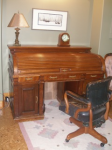
A beauty! I have no further information for you, but I do know you should be very proud of that desk!
KEVIN, be sure that I am! Now, I wonder how I can get the attention of Alley Antiques, who started this thread. I need to trade notes with him/her, to determine whether I have a Wooten desk or a very handsome Stahlschmidt copy. ~Rob
loyalist.relic - To contact Alley Antiques go to the members tab at the top of the page. Find Alley Antiques - click on their name and use the link to send them a message. woodwright
I bought my Turkish armchairs from Alley Antiques 6 years ago or so. I think that they also have a Ruby Lane shop (http://www.rubylane.com/shop/alleyantiques) . . . presuming that this is the same place.
- Jason
- Jason
WOODWRIGHT, thanks, I took your advice and have sent a message to Alley Antiques.
JASON, thanks too for your lead. I'll add to this string if I hear from him/her. ~Rob
JASON, thanks too for your lead. I'll add to this string if I hear from him/her. ~Rob
Nice collection of desks. Beautifully designed desks add to the beauty of a home/office.
It's been over a week with no reply from Alley Antiques to my personal message through this website. That fabulous desk probably whistled through their inventory and is now forgotten. Have a look at their website, though. http://www.rubylane.com/shop/alleyantiques They must be an online agent for many antiques dealers - the variety and quality of their pieces is amazing.
Hi all. I've loved reading all the posts. My family made the desks you've been talking about. If you'd like more information or to chat, please let me know. I've attached a photo of our desk - straight from the factory; two others exist. One was given to Queen Victoria, the other bought by a private collector. (don't mind the emptiness of the shelves - not really a good photo but had it on file - looks much better full) *the old books are from the 1800's and belonged to my great x3 grandfather who owned W. Stahlschmidt & Co.
Best, Toby Lyn Stahlschmidt-Kah
Best, Toby Lyn Stahlschmidt-Kah
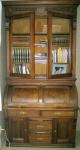
WOW, WOW, WOW! I feel like I've won a lottery! Toby Lyn, I am so pleased to hear from you. Just this week I found a Stahlschmidt family history website from Germany, http://members.kabsi.at/familienforschung/stahlschmidt_english_william_preston.html, which includes a photo of a Stahlschmidt rolltop desk similar to mine. Yours is much more elaborate but it also shows common roots with the Wooten line, out of Indianapolis.
I'll try to figure out if we can post private messages from this forum and will definitely be in touch!
Rob McDonald
Edmonton AB
I'll try to figure out if we can post private messages from this forum and will definitely be in touch!
Rob McDonald
Edmonton AB
Cool that this finally happened! Beautiful desk, too. I'll bet I could make room for one of them... ;D
That's a lot of room to make! The desk measures 3' wide x 5' long and the wings swing out another 12" on each side. It also wants to be out in the middle of the room because the panelling on the back is so beautiful. It's an ancestral burden that I'm happily willing to bear.
No doubt!! We should all have to bear such burdens.... ;D ;D