Hello all,
Apologies if this gets cross-posted -- I tried to submit it to the "Attributions" thread, and got an error message, so I am trying here.
I recently purchased this suite at auction. Although I'm a rabid collector of C19 decorative arts, I seldom buy furniture; but we needed a dining set, and I was quite taken by the Modern/Reform Gothic elements of this one: all the crockets, chevron molding, rosettes, chamfering, etc. one could ask for. The suite is in walnut, I believe American, but owing much to the design principles of Talbert and Eastlake. The table is simpler and more robust in form; the chairs are a bit fussier. But there are a lot of design elements in common, and if the chairs did not accompany the table originally, they complement it nicely, I think.
Any thoughts on possible makers, cities of origin, etc.?
Thanks for your help!
Eric
Reform Gothic dining set
Archive summary
Victorian Furniture thread on victorianforum.com · started January 4, 2013 by aesthete · 8 posts, 10 image attachments · discussion in 2013.
Hello all, Apologies if this gets cross-posted -- I tried to submit it to the "Attributions" thread, and got an error message, so I am trying here. I recently purchased this suite at auction. Although I'm a rabid collector of C19 decorative arts, I seldom buy furniture; but…
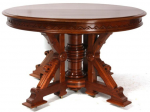
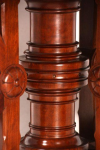
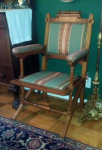
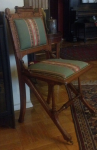

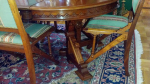
A nicely assembled set! The table looks to be 10-15 years older than the chairs, probably ca. 1870-75. The chairs are interesting; I've never seen those attenuated legs before. They seem to be Eastlake with aesthetic elements, ca. 1885-90.
I would imagine that these were not made by the same maker, but both table and chairs were probably made in the northeastern U.S., possibly as far west as Ohio or Michigan.
I would imagine that these were not made by the same maker, but both table and chairs were probably made in the northeastern U.S., possibly as far west as Ohio or Michigan.
Eric-
The table is stunning! Simple yet elegant and
perfectly proportioned to appeal to the
discriminating eye. Great find.
stever
The table is stunning! Simple yet elegant and
perfectly proportioned to appeal to the
discriminating eye. Great find.
stever
These pieces look very much like some examples I have seen by the Kilian Brothers company of New York. Imitation was rife during that period (as it still is), so I would recommend looking for an example documented to be by Killian Bros. that is either identical to yours or possesses features that are so close as to preclude the likelihood of anyone else being the creator.
In the meantime I would describe your dining set as "in the style of Kilian Bros."
In the meantime I would describe your dining set as "in the style of Kilian Bros."
Killian Brothers....good guess! :)
Thanks to all for the help and advice! So far the best lead I have comes from an album of photographs of furniture manufactured by the NY firm of Kimbel & Cabus ca. 1876-1890, posted online via the Smithsonian Institution site. The online images include photos of Modern Gothic chairs almost identical in structure (though not in decorative detail) to mine. If mine were ever signed the labels are now long gone; so the best attribution I can hope for is "in the manner of ..." But I plan to have a closer look at that Kimbel & Cabus album at the Cooper-Hewitt Library, on the off-chance that my chairs are represented among the many photos not available online.
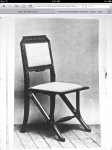
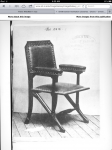
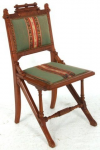
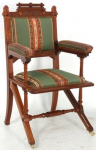
Looks close alright. If your chairs are not by them, then they're a pretty close imitation. Looks like New York.
Thanks for the encouraging words, Kevin. I'm trying not to be one of those pitiful collectors who grasp at unlikely attributions! I did some research with the Kimbel & Cabus albums at the Cooper Hewitt Museum Library--what a fabulous collection--but although I saw LOTS of Aesthetic Era pattern books I need to add to my own library, I didn't come away with anything I didn't already know. On the plus side, I've passed the pictures around to various colleagues in the Dec. Arts, and gotten some encouraging feedback. In the absence of solid evidence linking the set to Kimbel & Cabus the "high end knockoff" theory is probably the safest, but we'll see.