Ren. Revival chairs
Archive summary
Victorian Furniture thread on victorianforum.com · started May 12, 2013 by rixter · 20 posts, 3 image attachments · discussion in 2013.
Normally wouldn't look at painted furniture, but something about these chairs seem special. Maybe I should purchase them. There are seven. What are your thoughts about them?
Normally wouldn't look at painted furniture, but something about these chairs seem special. Maybe I should purchase them. There are seven. What are your thoughts about them?
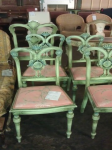
Hey, don't be afraid of paint, it's a VERY big deal in early american furniture. Is the paint original decoration on these chairs? It's my understanding that back in the day, painter's mixed their own paint and it was a distinct trade, then along about 1850 or so, paint became available in a can which kinda changed everything as now EVERYONE was a painter. Paint decoration on Victorian furniture is kinda rare, isn't it?
1690-1720 coastal Connecticut
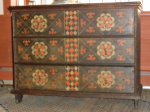
Here is a paint decorated chest i just purchased, original paint decorated furniture can really make ones collection unique as it's really kind of rare, no matter what era or style of furniture you collect.
Here is a paint decorated chest i just purchased, original paint decorated furniture can really make ones collection unique as it's really kind of rare, no matter what era or style of furniture you collect.
Renaissance Revival chairs such as these were not painted. These need to be stripped and refinished; there is probably some beautiful wood under there.
Beautiful chest Jacon, as I mentioned on the "other" forum.
Beautiful chest Jacon, as I mentioned on the "other" forum.
ahhhhhh haaaaaa, yeah, i suspected the paint wasnt original, i dont think i have seen much paint in victorian furniture as most of it was walnut which really does not lend itself to painting.
Whats your handle on the "other" forum?
Whats your handle on the "other" forum?
ghopper1924 ;)
LOL, ghopper huh, is that short for grass hopper? You are a victorian collector?
Yes and yes.
BINGO! I think we gotta winner over here!
Thats where i started collecting furniture many moons ago, victorian. But one day at auction, i came upon a painted early american chest and it was on "like a neck bone" as they say in the south. ( i have no idea what that means)
Hey, have you read "Objects of Desire?" Great book! I posted a "book report" about it down below.
Long story short: there is extensive information about a painted New England (Connecticut) 18th century blanket chest; it reminded me of you and your recent purchase.
Long story short: there is extensive information about a painted New England (Connecticut) 18th century blanket chest; it reminded me of you and your recent purchase.
No, hasnt, i cant find the book report.
OK, sees it now under general discussion.
Weird thing about this chest i just got, you might say it was mostly a "gift". I met this high end antique dealer online at a social networking site. As it turns out, this dealer had been beating my ass at auction for many YEARS! although we were not aware of it or each other at the time. Naturally, i never let this dealer forget the fact that i was just a "lil person" attempting to acquire this or that piece and i was being crushed at auction by folks with much deeper pockets. One thing led to another and before long i was researching pieces of interest to both of us which helped this dealer in marketing efforts. (i tend to know a lot about very little and most dealers are more generalist in their knowledge base)
Long story short, i was offered this piece as a "present" if i would please shut the hell up and stop making this dealer feel quilty about crushing the lil guy (me) at auction.
Hey, whatever it takes to get the piece!
OK, sees it now under general discussion.
Weird thing about this chest i just got, you might say it was mostly a "gift". I met this high end antique dealer online at a social networking site. As it turns out, this dealer had been beating my ass at auction for many YEARS! although we were not aware of it or each other at the time. Naturally, i never let this dealer forget the fact that i was just a "lil person" attempting to acquire this or that piece and i was being crushed at auction by folks with much deeper pockets. One thing led to another and before long i was researching pieces of interest to both of us which helped this dealer in marketing efforts. (i tend to know a lot about very little and most dealers are more generalist in their knowledge base)
Long story short, i was offered this piece as a "present" if i would please shut the hell up and stop making this dealer feel quilty about crushing the lil guy (me) at auction.
Hey, whatever it takes to get the piece!
Great story! I'd take that kind of "hush money" any day! ;D ;D
Quote from: kevin
Renaissance Revival chairs such as these were not painted. These need to be stripped and refinished; there is probably some beautiful wood under there.
I normally read posts such as this one and just shake my head and move on. But I'm afraid someone might read this nonsense and actually strip the 19th century paint from furniture known as "Victorian Cottage Furniture."
Hardwood
They might, but they won't, because they're not.
Nice post though.
Nice post though.
Yeah, I am going with Kevin on this one, although victorian painted is around, it's almost always flowers, vines, etc. I dont think i've ever seen victorian painted a solid color like that except sometimes ebonized or black to highlight inlays.
Right!
To elaborate a bit, "cottage" furniture was painted in part to make up for the fact that it was generally plainer and less elaborated under the paint. Therefore, the painting was used as an aid to sell furniture that may have been of lesser quality.
These chairs are clearly well elaborated, probably walnut beneath that green paint. Paint that was obviously applied later.
Maybe it's time to just shake our heads at the idea that these chairs are "cottage" furniture and just move on....
To elaborate a bit, "cottage" furniture was painted in part to make up for the fact that it was generally plainer and less elaborated under the paint. Therefore, the painting was used as an aid to sell furniture that may have been of lesser quality.
These chairs are clearly well elaborated, probably walnut beneath that green paint. Paint that was obviously applied later.
Maybe it's time to just shake our heads at the idea that these chairs are "cottage" furniture and just move on....
My reply was to Kevin’s statement that, “Renaissance Revival chairs such as these were not painted. These need to be stripped and refinished; there is probably some beautiful wood under there.”
I wasn’t arguing that the chairs in rixter’s post are original 19th century, painted, Victorian chairs.
In fact, these chairs are most likely not 19th century (need to see more pictures of the construction). They appear to be made within the past 50 years. Take a look at the front and side seat rails where it meets the cushion. Notice how it extends past the frame with a rolling edge? This is not typical Victorian construction. The paint looks to be sprayed on with added shadowing from the factory. Under the paint is most likely pine.
My friend’s parents had a 1970’s table and chairs very similar to these. There was a brief period, not so long ago, where this type of factory painted furniture was popular and you still see plenty of this type of furniture in second hand stores.
The one thing to take away from my original post is that Renaissance Revival furniture from 1860 to 1885 was sometimes painted from the factory. It’s called “Cottage” furniture. Don’t strip antique furniture just because it’s painted – sometimes it’s original!
Hardwood
I wasn’t arguing that the chairs in rixter’s post are original 19th century, painted, Victorian chairs.
In fact, these chairs are most likely not 19th century (need to see more pictures of the construction). They appear to be made within the past 50 years. Take a look at the front and side seat rails where it meets the cushion. Notice how it extends past the frame with a rolling edge? This is not typical Victorian construction. The paint looks to be sprayed on with added shadowing from the factory. Under the paint is most likely pine.
My friend’s parents had a 1970’s table and chairs very similar to these. There was a brief period, not so long ago, where this type of factory painted furniture was popular and you still see plenty of this type of furniture in second hand stores.
The one thing to take away from my original post is that Renaissance Revival furniture from 1860 to 1885 was sometimes painted from the factory. It’s called “Cottage” furniture. Don’t strip antique furniture just because it’s painted – sometimes it’s original!
Hardwood
Yeah! Thats what I am talkin about! Let's Get some discussion going on this board, dead over here.
So, I am guessing hardwood claims that these are modern victorian revival chairs built in the last few decades? I dunno, could be.
This is what i think of when referring to late victorian cottage painted pine furniture.
http://www.skinnerinc.com/search?s=Cottage+Commode
It's my understanding that some of this furniture has been stripped and repainted in a "shabby cottage" or sometimes chalk decoration.
So, I am guessing hardwood claims that these are modern victorian revival chairs built in the last few decades? I dunno, could be.
This is what i think of when referring to late victorian cottage painted pine furniture.
http://www.skinnerinc.com/search?s=Cottage+Commode
It's my understanding that some of this furniture has been stripped and repainted in a "shabby cottage" or sometimes chalk decoration.
After Hardwood's latest post it's difficult to establish what, exactly, IS being discussed here.
These chairs are not "cottage style," nor would most people mistake them for that. Whether they're walnut or pine, they've been painted later and could easily be stripped and refinished in a way that accentuates the wood underneath, which is how they would have been finished whether they were made in 1880 or 1950.
BTW, I always favor saving the original finish if at all possible.
"Cottage style" is well illustrated in a couple of examples in Jacon's link. Those examples underline my thesis that this "style" is a more a manner of painting providing decoration/elaboration at less cost than carving. Thus, MOST examples tend to be more rather than less plain, under the paint. And yes, actual "cottage" -painted examples, far more common in the Eastlake era in, say, the 1890s, should be preserved if at all possible, never stripped.
Shabby chic and "cottage" are not the same thing by any means.
These chairs are not "cottage style," nor would most people mistake them for that. Whether they're walnut or pine, they've been painted later and could easily be stripped and refinished in a way that accentuates the wood underneath, which is how they would have been finished whether they were made in 1880 or 1950.
BTW, I always favor saving the original finish if at all possible.
"Cottage style" is well illustrated in a couple of examples in Jacon's link. Those examples underline my thesis that this "style" is a more a manner of painting providing decoration/elaboration at less cost than carving. Thus, MOST examples tend to be more rather than less plain, under the paint. And yes, actual "cottage" -painted examples, far more common in the Eastlake era in, say, the 1890s, should be preserved if at all possible, never stripped.
Shabby chic and "cottage" are not the same thing by any means.